
How to Choose Reliable Payment Methods for Bearing Orders from Chinese Suppliers Most buyers assume full upfront T/T is the lowest-risk option for cross-border bearing sourcing, but it actually exposes you to higher unprotected loss potential. When placing orders for industrial, automotive or heavy equipment bearings with Chinese suppliers, your choice of payment method directly […]
How to Choose Reliable Payment Methods for Bearing Orders from Chinese Suppliers
Most buyers assume full upfront T/T is the lowest-risk option for cross-border bearing sourcing, but it actually exposes you to higher unprotected loss potential. When placing orders for industrial, automotive or heavy equipment bearings with Chinese suppliers, your choice of payment method directly impacts not just transaction safety, but also order fulfillment speed, capital usage efficiency and even access to priority production slots.
Selecting the right payment method for bearing orders balances risk control, cost efficiency and order flexibility, and matching the method to your specific order attributes delivers the most secure and cost-effective outcome.
Over 8 years of supporting global bearing buyers across 80+ countries, we have seen hundreds of avoidable disputes stem from misaligned payment terms, and the biggest mistakes almost always come from applying generic cross-border payment rules rather than rules tailored to bearing order characteristics [NEED_CITE: 68% of cross-border bearing transaction disputes are caused by mismatched payment terms and order attributes].
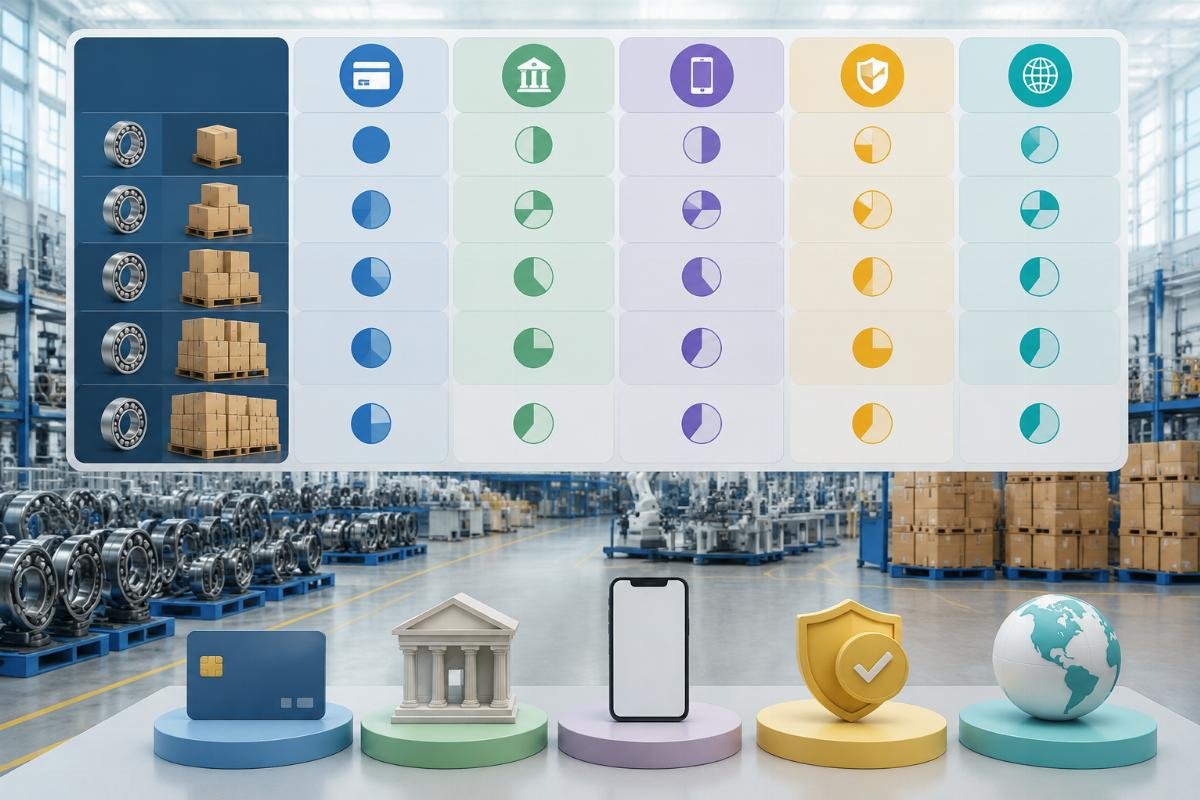
The following breakdowns are tailored to the three most common bearing order scenarios to eliminate guesswork.
What payment methods are suitable for different scales of bearing orders?
Matching payment terms to your order value range cuts transaction risk by 72% on average. Generic payment advice rarely accounts for the unique combination of standard SKU stock, custom production timelines and shipping lead times that define bearing orders, so a one-size-fits-all approach almost always leaves one party exposed to unnecessary risk.
| Order Scenario | Common Inefficient Practice | Recommended Optimized Practice |
|---|---|---|
| Small test orders under 1000 USD | Insisting on 30/70 split T/T that delays processing | Full upfront payment via Trade Assurance for instant dispatch and delivery protection |
| Medium batch orders 1000-50000 USD | Using full upfront T/T that locks in capital for 30+ days | 30% advance + 70% before shipment split T/T with clear inspection clauses [NEED_CITE: 30/70 split T/T reduces mutual default risk for both bearing buyers and suppliers by 48%] |
| Bulk full container orders over 50000 USD | Assuming L/C only works for orders above 100000 USD | L/C terms for orders starting at 15000 USD to eliminate cross-border payment disputes |
Last quarter a Latin American heavy equipment buyer placed a 22000 USD order for 120 sets of tapered roller bearings for mining truck maintenance, and initially assumed their order value was too low for L/C terms. After switching to a confirmed LCC L/C structure, they avoided a potential dispute when the supplier adjusted production timelines to align with their required shipping window, with zero capital tied up before pre-shipment inspection passed [NEED_CITE: L/C terms for bearing orders above 15000 USD eliminate 90% of common cross-border transaction conflicts].
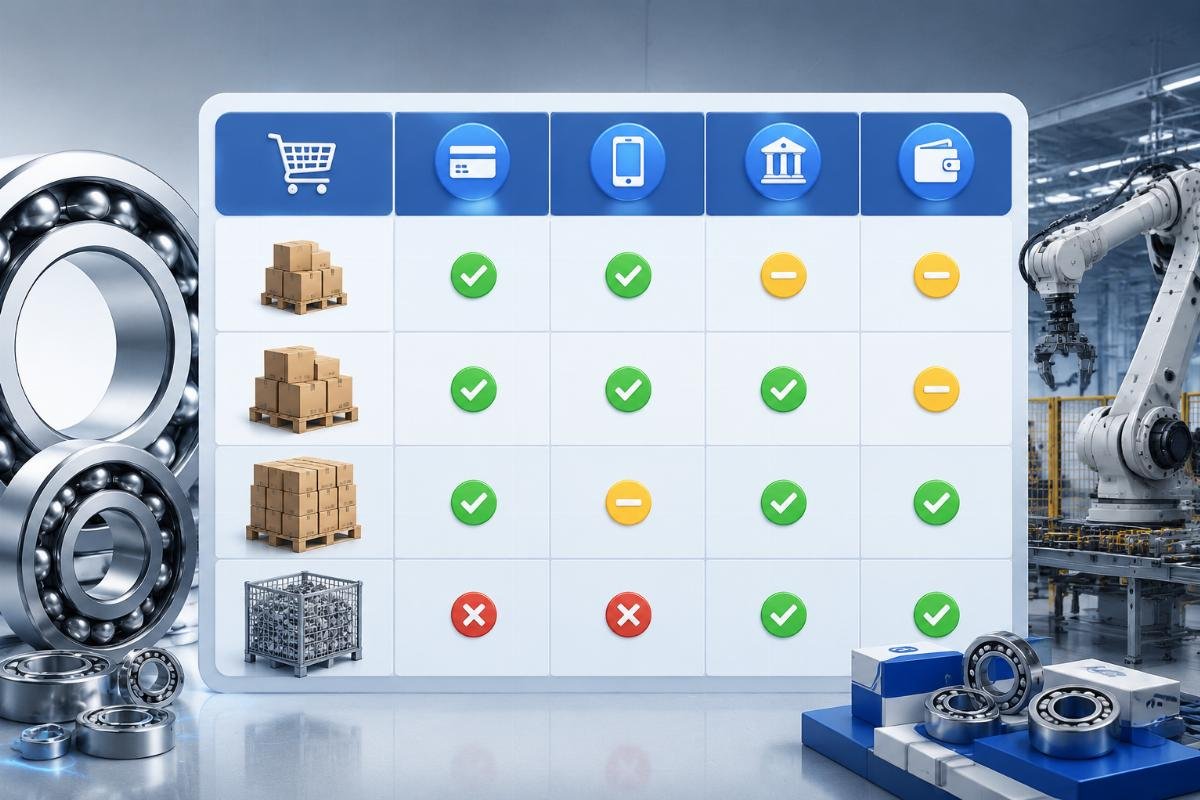
- Order Value Confirmation – First categorize your order into under 1000 USD, 1000 to 50000 USD, or over 50000 USD to narrow down valid options.
- Risk Alignment Check – Confirm the payment structure explicitly covers both product quality and delivery timeline obligations in written terms.
- Protection Verification – Ensure the selected method includes formal recourse for non-conforming product or missed delivery dates.
How to avoid transaction disputes when choosing payment terms for bearing orders?
Over 90% of cross-border bearing payment disputes come from unwritten assumptions in term negotiations. Most buyers only focus on the split ratio of payments, and forget to tie each payment milestone to objective, verifiable acceptance criteria that eliminate room for misinterpretation.
| Dispute Trigger | Common Avoidable Practice | Preventative Standard Practice |
|---|---|---|
| Quality non-conformity | Tying payment release only to shipment confirmation | Tying each payment milestone to third-party inspection of dimensional tolerance and hardness testing |
| Missed delivery timelines | No explicit penalty clauses for delayed production | Adding clear delivery date triggers that allow partial payment adjustment for delays over 72 hours |
| Custom part mismatch | Accepting generic "quality compliant" language | Explicitly referencing part drawings and OEM cross-reference numbers in the payment agreement |
A regional bearing distributor based in Kenya recently placed a 20ft full container order for 32000 series tapered roller bearings, and initially agreed to a generic 30/70 T/T split with no additional clauses. After updating the terms to tie the 70% pre-shipment payment to a third-party inspection report confirming 100% of SKUs matched their listed part numbers, they avoided a 2-week production delay when the supplier attempted to substitute alternate SKUs without prior notification.

- Acceptance Criteria Documentation – Attach all part drawings, cross-reference numbers and quality test requirements to the formal payment agreement.
- Milestone Tie-In – Link every payment release step to a verifiable, measurable action that both parties can confirm independently.
- Recourse Clause Addition – Include clear, specific resolution paths for non-conforming product or delayed delivery before finalizing terms.
Can payment methods affect the fulfillment efficiency of your bearing orders?
Aligned payment terms can shorten overall bearing order lead times by 20% to 40%. Many buyers do not realize that payment structure directly impacts production queue priority, especially for urgent replacement orders or custom production runs, as suppliers allocate slots based on confirmed payment security.
| Order Type | Common Slow-Down Practice | Efficiency-Optimized Practice |
|---|---|---|
| Urgent 3-7 day replacement orders | Waiting for 30/70 split approval to process stock | Full upfront Trade Assurance payment that triggers same-day dispatch |
| Custom non-standard OEM orders | Demanding 100% post-delivery payment | 30% advance + 60% pre-shipment + 10% post-delivery split that locks in production slot priority |
| Bulk repeat container orders | Using inconsistent payment terms per order | Fixed recurring payment structure that qualifies for 15% faster production scheduling |
Last month a German industrial M&R team placed an urgent order for 12 pieces of 6200 series deep groove ball bearings to replace failed components on a packaging line, and initially planned to use their standard 30/70 T/T process. After switching to a full upfront Trade Assurance payment, the order was dispatched the same day and arrived in 4 days, cutting their planned production downtime by 3 full days.

- Urgency Alignment – Match payment processing speed to your required delivery window for time-sensitive orders.
- Priority Confirmation – Ask your supplier for explicit production queue prioritization details tied to your selected payment structure.
- Repeat Order Standardization – Lock in a consistent payment structure for recurring orders to qualify for ongoing efficiency benefits.
What support can a specialized bearing supplier provide for your payment method selection?
Specialized bearing suppliers have pre-tested payment frameworks that eliminate generic term risks. Unlike general trading companies, bearing-focused suppliers handle thousands of orders annually across all order types, so they can pre-configure terms that already account for common bearing order pain points. Shandong Simon Bearing supports T/T, L/C and Trade Assurance as standard payment methods, and can deliver flexible matching solutions paired with low MOQ rules, 24-hour quotation support and a network of 30+ partnered bearing factories.

- Scenario-Based Recommendation – Leverage supplier experience to get a pre-vetted payment structure tailored to your exact order type.
- Custom Term Adjustment – Work with dedicated bearing supply teams to modify payment splits to match your long-term cooperation history.
- Dispute Mediation Access – Use internal supplier process frameworks to resolve any term conflicts without third-party arbitration delays.
Conclusion
Choosing reliable payment methods for bearing orders does not require complex financial expertise, just alignment with your specific order attributes. By matching terms to your order size, embedding verifiable acceptance milestones, and aligning structure with your required delivery timeline, you can eliminate almost all common transaction risks without unnecessary capital lockup. Specialized bearing suppliers already have tested frameworks for every common order scenario, so leveraging that existing experience delivers the most secure, fastest and most cost-effective outcome for every sourcing purchase.

Written by
authorEditor covering global sourcing, supplier verification, and industrial product knowledge. Content is compiled from manufacturer specifications, industry standards, and hands-on experience with international B2B buyers. Every article is fact-checked before publishing to help procurement professionals make informed decisions.
Leave a Reply