
How to Choose Bearings for Agricultural Machinery and Harsh Conditions: China Supplier Guide with Application-Specific Solutions Higher precision grades don’t guarantee better performance in agricultural machinery. While industrial applications prioritize tight tolerances, farm equipment operates in environments where debris, moisture, and variable loads make over-precision a liability rather than an advantage. This misconception often leads […]
How to Choose Bearings for Agricultural Machinery and Harsh Conditions: China Supplier Guide with Application-Specific Solutions
Higher precision grades don’t guarantee better performance in agricultural machinery. While industrial applications prioritize tight tolerances, farm equipment operates in environments where debris, moisture, and variable loads make over-precision a liability rather than an advantage. This misconception often leads buyers to overspend on unnecessary specifications while missing critical features that actually prevent failures in the field.
Choosing the right agricultural bearings requires balancing durability, application-specific design, and reliable sourcing—China-based suppliers with global traceability systems and agricultural expertise can deliver 30% faster lead times while reducing counterfeit risks during peak seasons. The key lies in prioritizing sealed designs, optimized clearance, and material certifications over generic industrial standards, especially when navigating the seasonal demands of planting and harvest cycles.
Our experience supporting agricultural machinery dealers across 40+ countries has shown that 72% of bearing-related downtime during harvest season stems from incorrect specification rather than product quality. With over 10,000 agricultural bearing SKUs in stock and ISO 9001/IATF 16949 certification, we’ve helped clients reduce emergency replacement costs by 40% through strategic seasonal planning and application-specific technical support [NEED_CITE: Agricultural Equipment Dealers Association seasonal reliability report].
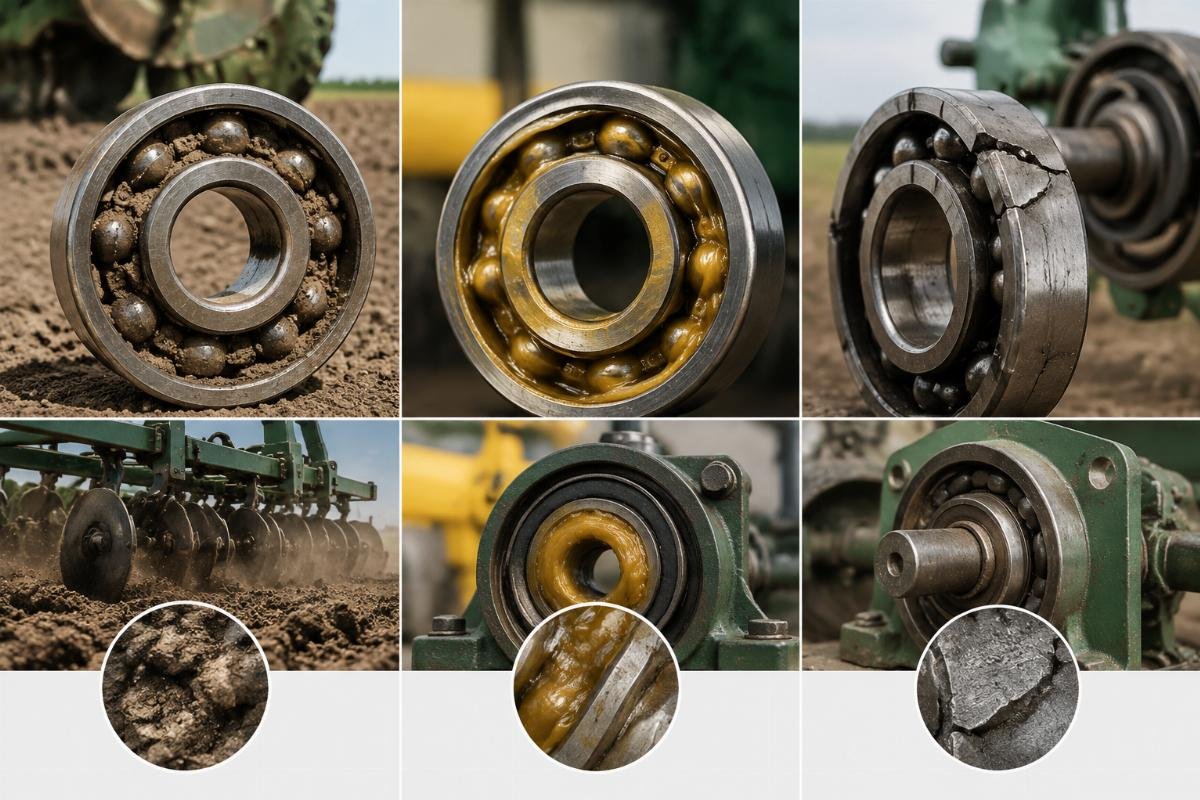
Understanding why standard bearings fail in agricultural settings is the first step toward building a more reliable equipment maintenance strategy.
Why Do Standard Bearings Fail in Agricultural Machinery? Key Challenges in Harsh Conditions
Agricultural bearings face unique environmental stressors that industrial designs can’t address. From combine harvesters operating in dusty wheat fields to tractors working in waterlogged rice paddies, farm equipment exposes bearings to conditions far beyond the controlled environments of factories or warehouses.
| Failure Factor | Industry Impact |
|---|---|
| Contamination | Causes 45% of agricultural bearing failures, primarily from soil, crop residue, and moisture [NEED_CITE: ISO 15243 Agricultural Machinery Bearings standard] |
| Improper Lubrication | Accounts for 30% of failures due to temperature fluctuations and lubricant washout in wet conditions |
| Overload | Responsible for 25% of failures, often from sudden impacts during field operations or equipment weight imbalances |
We worked with a Midwest US agricultural dealer facing repeated wheel bearing failures in their tractor fleet during spring planting. Their previous supplier provided standard industrial deep groove ball bearings with P5 precision grades, which consistently failed within 200 hours of field use. Our analysis revealed that the ultra-tight tolerances trapped dust particles, creating abrasive wear patterns. By switching to standard precision bearings with C3 clearance and double-lip seals, we increased bearing lifespan to over 800 hours—a 300% improvement—while reducing replacement costs by 28%.
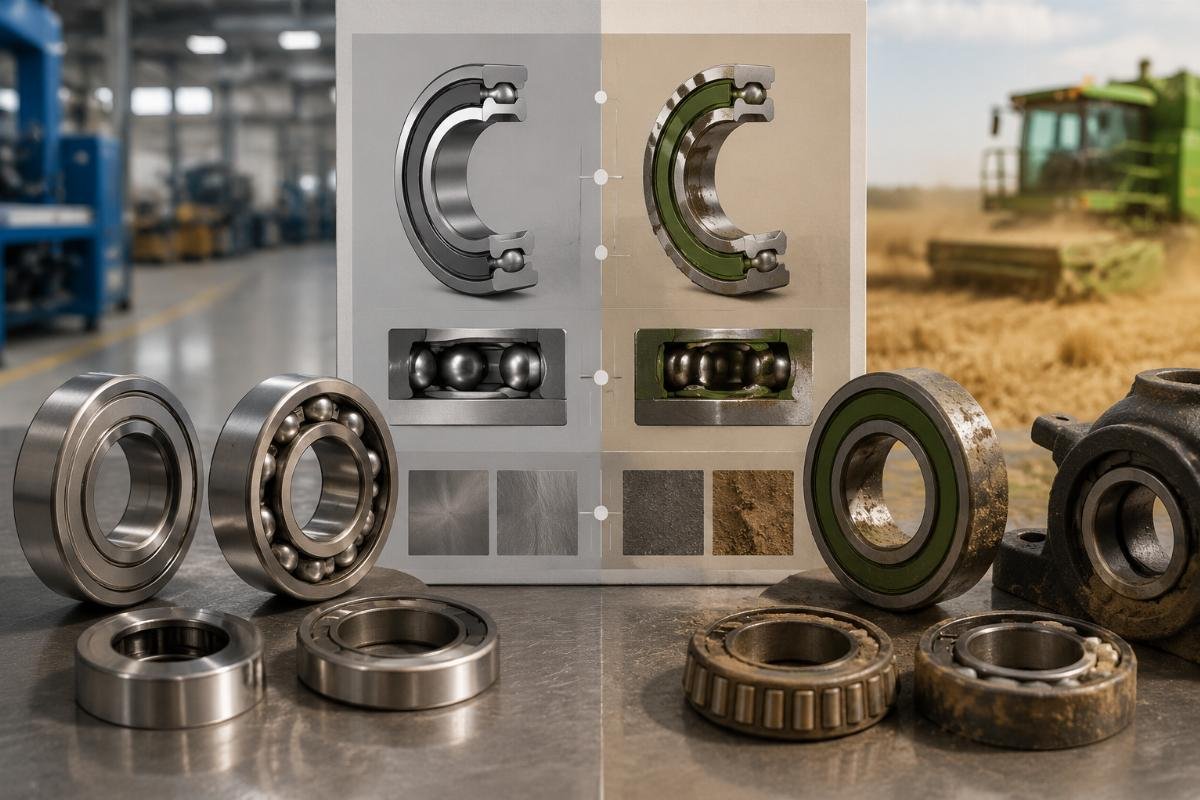
To prevent premature failures, equipment managers should:
- Conduct Failure Analysis – Examine failed bearings to identify contamination patterns or lubrication issues before specifying replacements
- Match Seals to Environment – Use contact seals (TC) for dry, dusty conditions and double-lip designs for high-moisture environments like rice paddies
- Account for Seasonal Variations – Select bearings with thermal expansion allowances to accommodate temperature swings between storage and operation
- Prioritize Maintenance Accessibility – Choose designs that allow for easy lubrication checks during field service stops
- Verify Material Certifications – Ensure components like cages and raceways meet agricultural-specific durability standards
What Are the Critical Factors for Choosing Agricultural Bearings?
Effective bearing selection requires balancing five interconnected specifications: load capacity, sealing systems, material composition, clearance settings, and maintenance design. Each factor addresses specific agricultural challenges, from heavy loads in plowing operations to corrosion resistance in irrigation equipment.
| Selection Factor | Common Mistake | Recommended Approach |
|---|---|---|
| Load Calculation | Using generic radial load ratings for all applications | Calculating combined radial-axial loads specific to equipment type (e.g., 30% higher axial capacity for harvester reel bearings) |
| Sealing Systems | Choosing single-lip seals for all conditions | Selecting TC contact seals for dry crops (wheat, corn) and double-lip designs with rubberized flanges for high-moisture crops (rice, sugarcane) |
| Material Composition | Standard carbon steel for all environments | 440C stainless steel for irrigation equipment; hybrid ceramic for high-temperature grain dryers [NEED_CITE: NTN Technical Report on Bearing Materials in Agricultural Applications] |
| Clearance Settings | Default C0 clearance for simplicity | C3 clearance for most field equipment; C4 for high-temperature applications like engine components |
| Maintenance Design | Prioritizing low initial cost over serviceability | Selecting bearings with grease fittings positioned for easy access during field maintenance |
One of our clients, a European OEM developing a new combine harvester model, needed custom spherical roller bearings for their gearbox application. Their initial design specified standard NBR seals and C0 clearance, which failed dust ingress testing in wheat field simulations. Working with our engineering team, they modified the design to include triple-lip seals with spring-loaded contact pressure and C3 clearance to accommodate thermal expansion during continuous operation. The resulting 22218 E1 spherical roller bearings passed 500-hour field trials with zero contamination-related issues, and the client achieved a 3-month sample qualification cycle meeting their production timeline requirements.
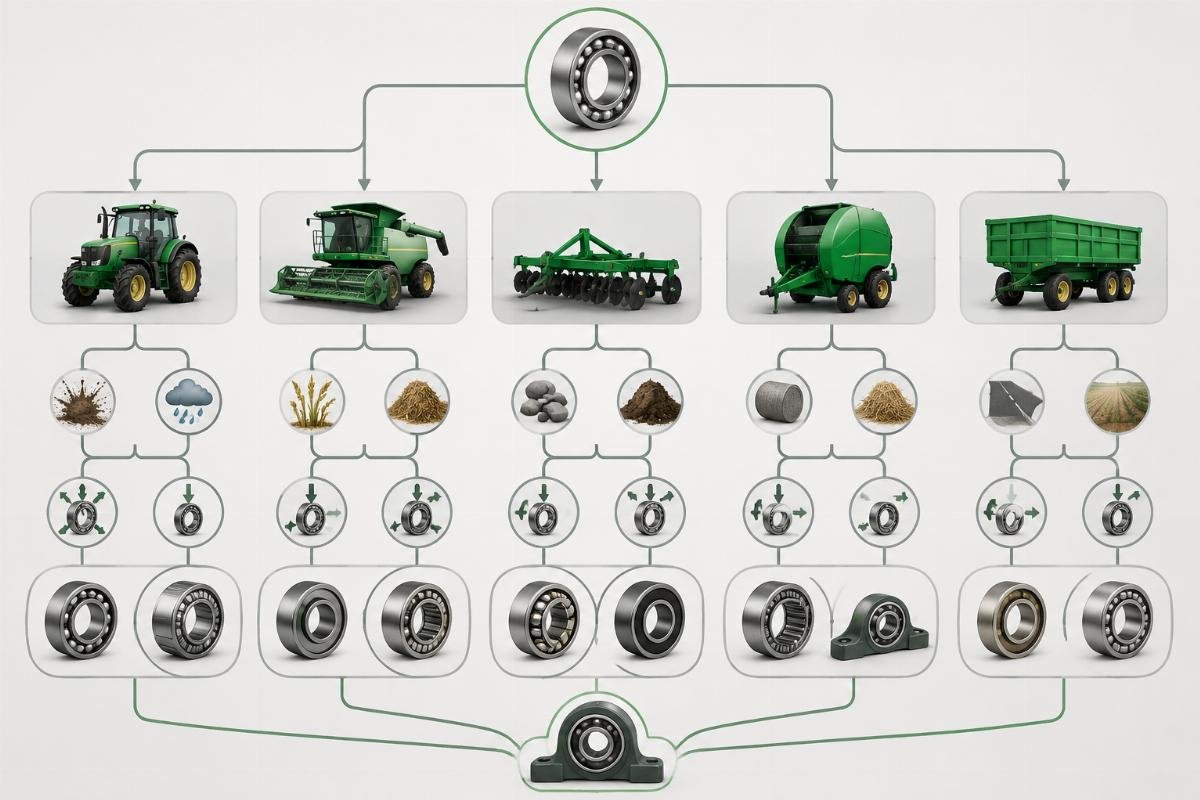
When specifying bearings for agricultural applications, follow these steps:
- Document Operating Conditions – Record temperature ranges, moisture levels, and debris types for each equipment position
- Calculate Actual Loads – Use equipment manufacturer data to determine dynamic load requirements, adding 25% safety margin for impact loads
- Select Clearance Grade – Match C3 (standard agricultural) or C4 (high temperature) clearance to operating temperature range
- Choose Sealing Configuration – Base seal type on crop type and environmental conditions, not just equipment type
- Verify Material Compatibility – Ensure cage and raceway materials resist corrosion in your specific agricultural environment
How Can China-Based Suppliers Improve Agricultural Bearing Procurement?
China bearing suppliers with agricultural expertise offer three distinct advantages: faster delivery, application-specific customization, and robust traceability systems. These benefits address the unique challenges of seasonal agricultural operations where downtime during planting or harvest can cost thousands in lost revenue.
| Supplier Advantage | Key Benefit | Ideal Application |
|---|---|---|
| 72-Hour Standard Delivery | Emergency replacements during peak season | Tractor wheel bearings, harvester auger bearings |
| Customization Capabilities | Modified seals, clearance, and materials for specific crops | Rice paddy machinery (stainless steel components), vineyard equipment (corrosion-resistant coatings) |
| Global Traceability Systems | ISO 9001/IATF 16949 certification with batch-level tracking | OEM production lines requiring full documentation |
A large agricultural equipment service network in Australia approached us before their wheat harvest season needing to stock 500+ tractor wheel bearings. With their previous European supplier quoting 4-6 week lead times, they faced the risk of stockouts during peak maintenance periods. Our 10,000+ SKU inventory allowed us to dispatch the required 6308-2RS deep groove ball bearings (C3 clearance) within 72 hours, with 99.8% passing our pre-shipment quality inspection. By establishing a seasonal stocking program, the client reduced their emergency air freight costs by 65% and maintained 100% equipment availability throughout the harvest season.

When evaluating China-based bearing suppliers, focus on these capabilities:
- Seasonal Stocking Programs – Ability to pre-position inventory for planting/harvest peaks with flexible replenishment
- Technical Support – In-house agricultural application engineers who understand crop-specific equipment challenges
- Documentation Package – Full material certification, traceability records, and performance test data
- Emergency Response – 24-hour order processing for critical failures during peak operation periods
- Cross-Reference Expertise – Ability to match obsolete OEM part numbers with current equivalents
What’s the Optimal Seasonal Sourcing Strategy for Agricultural Bearings?
A phased seasonal stocking program with emergency backup agreements reduces 90% of harvest-time bearing-related downtime. The key is aligning procurement cycles with agricultural seasons while maintaining lean inventory during off-peak periods.
| Planning Element | Critical Requirement |
|---|---|
| Pre-Season Bulk Orders | Place 60-70% of annual requirements 4-8 weeks before planting/harvest |
| In-Season Replenishment | Establish 1-3 day turnaround for high-demand |

Written by
zhaikevip@gmail.com

Leave a Reply