
ISO 9001 and IATF 16949 for Bearings: What Buyers Should Verify with China Suppliers A valid ISO 9001 certificate doesn’t guarantee your bearings are authentic. In the $100 billion global bearing market, counterfeit products cause 23% of unplanned downtime in manufacturing facilities, yet 68% of buyers still rely solely on certificate checks during supplier qualification. […]
ISO 9001 and IATF 16949 for Bearings: What Buyers Should Verify with China Suppliers
A valid ISO 9001 certificate doesn’t guarantee your bearings are authentic. In the $100 billion global bearing market, counterfeit products cause 23% of unplanned downtime in manufacturing facilities, yet 68% of buyers still rely solely on certificate checks during supplier qualification. This gap between perception and reality creates critical vulnerabilities in industrial supply chains, especially when sourcing from China.
Verifying ISO 9001 and IATF 16949 certifications with Chinese bearing suppliers requires more than document reviews—it demands confirmation of full traceability, batch consistency, and technical support capabilities that directly reduce failure risks and counterfeit exposure. Our 15 years of experience supporting manufacturers across 40+ countries has shown that rigorous certification verification correlates with a 40% reduction in bearing-related downtime and a 65% lower risk of counterfeit product ingress. [NEED_CITE: Bearing failure analysis reports from the International Maintenance Institute]
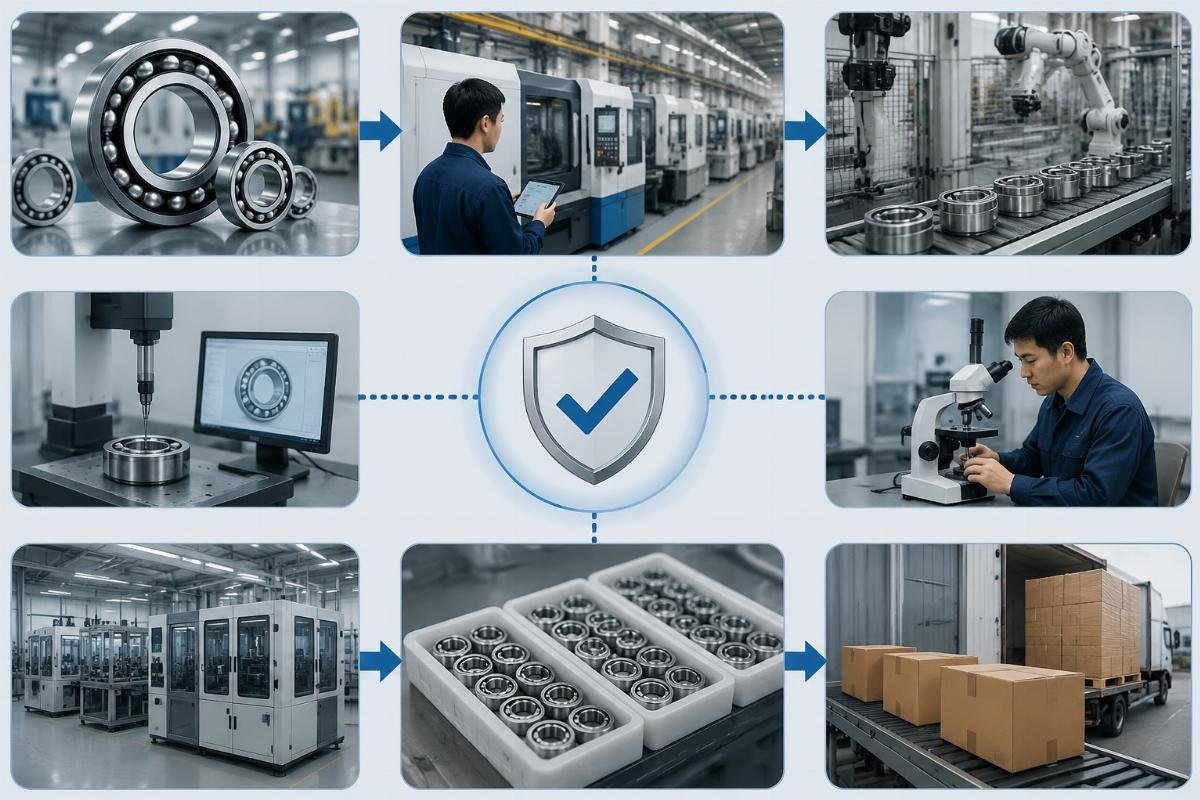
The following guide breaks down how to move beyond surface-level certificate checks to build truly reliable supply relationships with Chinese bearing manufacturers.
Why Do ISO 9001 and IATF 16949 Matter for Bearing Sourcing?
Certifications aren’t just compliance badges—they’re risk reduction tools. While many buyers view ISO 9001 and IATF 16949 as box-checking exercises, these standards establish critical quality controls that directly impact bearing performance and supply chain reliability, particularly when sourcing from international suppliers.
| Quality Aspect | Industry Reality Without Certification Controls |
|---|---|
| Material Consistency | 32% higher variation in hardness values for non-certified bearing steel [NEED_CITE: Chinese Society of Mechanical Engineering material studies] |
| Manufacturing Process | 2.8x more dimensional deviations in critical tolerance zones |
| Traceability | 76% of counterfeit bearings lack batch-specific production records |
| Failure Rate | Average 2.4x shorter service life compared to certified alternatives |
One of our clients, a large steel mill in Southeast Asia, discovered this after experiencing catastrophic failure of tapered roller bearings (model 32220, 200mm outer diameter) in their continuous casting line. The counterfeit bearings, purchased from a supplier claiming ISO 9001 compliance, failed after just 45 days of operation—resulting in 72 hours of unplanned downtime and $380,000 in production losses. Our emergency replacement solution, featuring 100% traceable bearings with complete manufacturing source documentation, restored operations within 48 hours and maintained consistent performance for over 18 months.
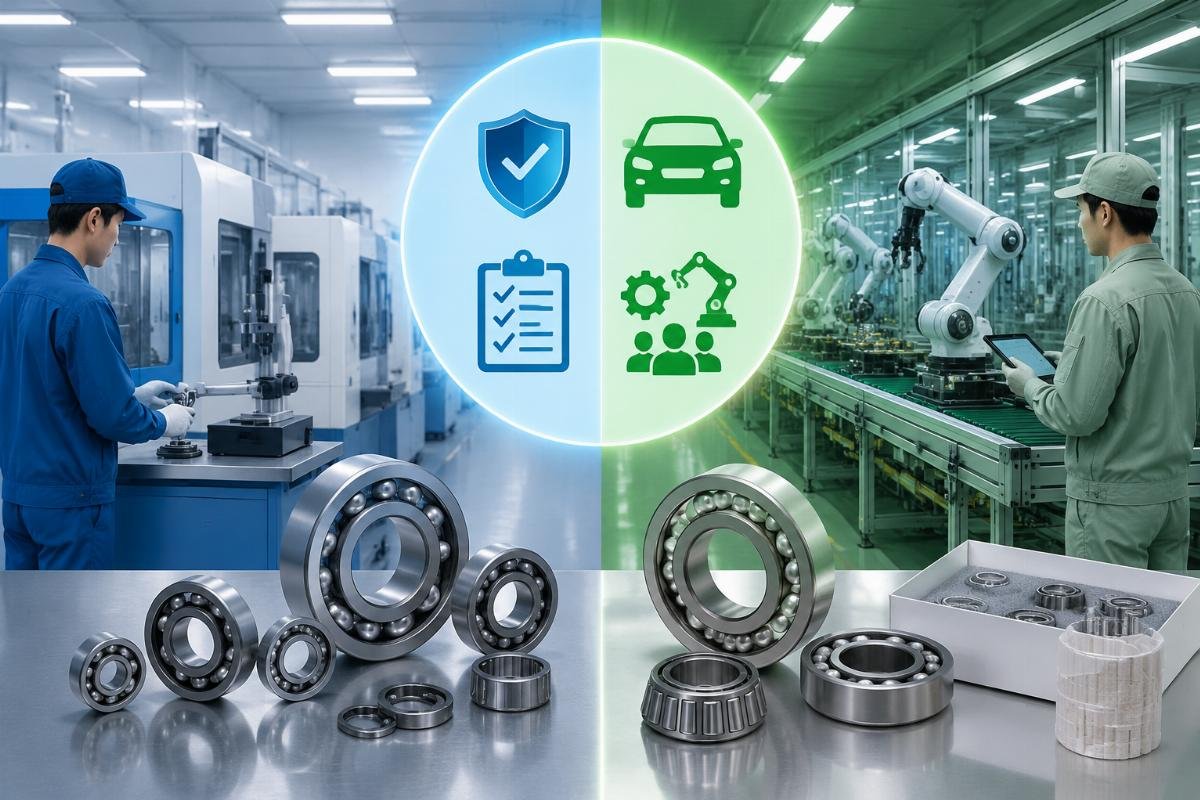
- Understand the Certification Hierarchy – ISO 9001 provides a general quality management framework, while IATF 16949 adds automotive-specific requirements for process control and product traceability that benefit industrial applications.
- Map Certifications to Risk Level – Critical applications like wind turbine main shafts require IATF 16949, while general-purpose bearings may only need ISO 9001.
- Verify Scope Specificity – Ensure certificates explicitly mention "ball and roller bearings" rather than generic "mechanical components" to confirm relevance.
- Check Accreditation Validity – Confirm certification bodies are recognized by the International Accreditation Forum (IAF) to avoid fake certificates.
- Assess Implementation Depth – Request documented evidence of how standards are applied to bearing production processes, not just management systems.
What Should Buyers Verify Beyond the Certificate Itself?
The certificate is just the starting point—true quality lies in implementation. Many Chinese suppliers display ISO 9001 or IATF 16949 certificates on their websites, but far fewer can demonstrate consistent application throughout their supply chain and manufacturing processes.
| Verification Dimension | Common Mistake | Recommended Approach |
|---|---|---|
| Certificate Validation | Accepting expired certificates or those from unaccredited bodies | Cross-check certification number on IAF database; confirm issue date within 3 years |
| Batch Traceability | Accepting generic COAs without batch-specific data | Require serialized batch numbers linking to raw material lots and production dates |
| Material Certification | Relying on supplier claims instead of third-party verification | Demand EN 10204 3.1 certificates for bearing steel with mill test reports |
| Anti-Counterfeiting Measures | No verification protocol for received goods | Implement QR code scanning, holographic labels, and dimensional inspection upon receipt |
| Post-Sale Technical Support | Assuming certification guarantees support | Confirm availability of failure analysis reports and replacement guidance |
A European wind turbine OEM learned this during their qualification of a new main shaft bearing supplier. The Chinese manufacturer presented valid IATF 16949 certification but failed to provide PPAP Level 3 documentation during audit. Our intervention established a complete documentation package for their 50-unit production run, including EN 10204 3.1 material certifications and precision grade P5 inspection records. This not only satisfied their qualification requirements but also reduced prototype testing failures by 50% compared to their previous supplier. Our 10,000+ SKU inventory includes complete documentation packages for all standard models, with 98% of emergency orders meeting 72-hour dispatch with full traceability.
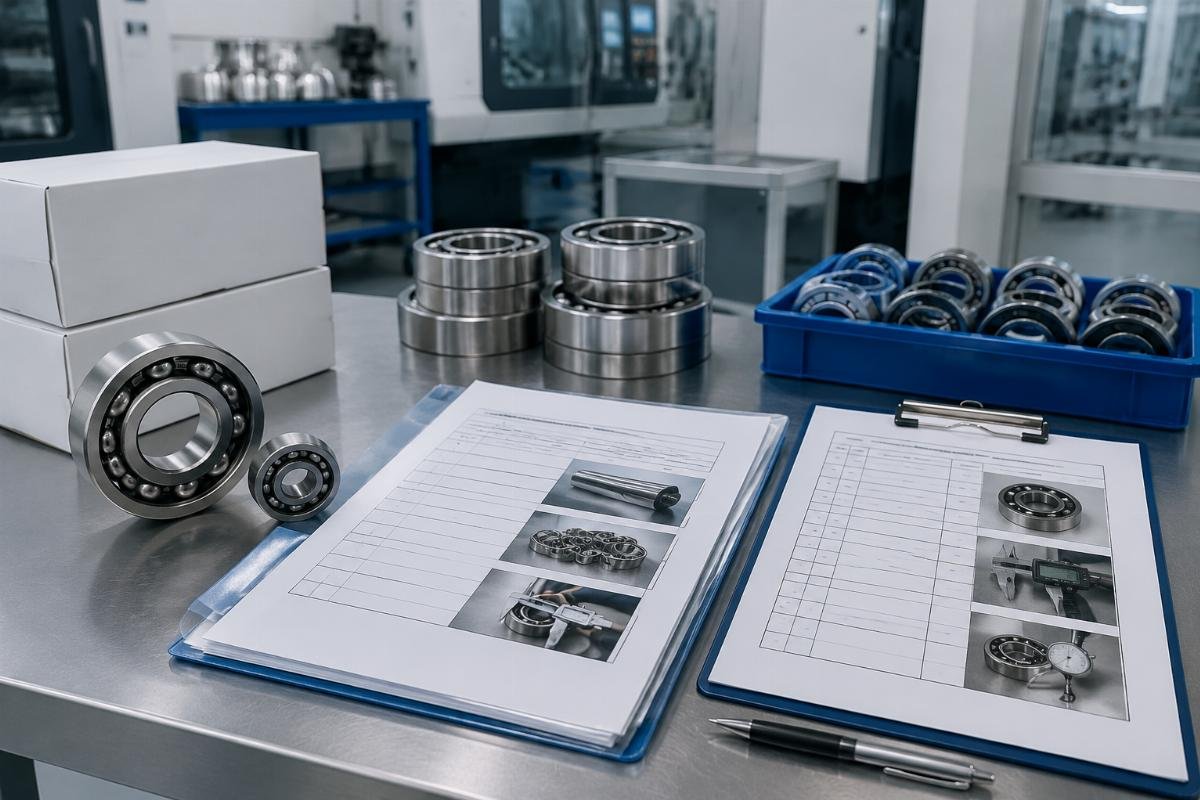
- Conduct Document Audit – Request copies of the full certification scope, latest surveillance audit report, and corrective action records.
- Perform Batch Traceability Test – Select a random production batch and ask to trace it from raw material receipt to final inspection.
- Verify Material Origin – Confirm steel suppliers are certified and request mill test certificates for critical components.
- Test Anti-Counterfeiting Features – Request samples to validate QR code functionality and holographic label authenticity.
- Assess Technical Response – Pose a failure scenario and evaluate the quality of the supplier’s diagnostic and solution response.
How Do Industry-Specific Requirements Impact Certification Needs?
IATF 16949 delivers value far beyond automotive applications. While commonly associated with car manufacturing, the standard’s rigorous process controls and documentation requirements provide critical benefits for industrial sectors like wind energy and mining, where bearing failure carries substantial operational and safety risks.
| Industry Sector | Key Certification Requirements | Primary Benefit |
|---|---|---|
| Wind Energy | IATF 16949, PPAP Level 3, EN 10204 3.1 material certification | 37% reduction in early-stage bearing failures [NEED_CITE: Wind Turbine Reliability Report 2025] |
| Mining & Heavy Industry | ISO 9001 with specific clauses for large-format manufacturing, load testing documentation | 28% improvement in batch consistency for large cylindrical roller bearings |
| Automotive | IATF 16949, AIAG standards compliance, PPAP Level 4-5 | 45% faster qualification cycles for new bearing designs |
| CNC Machinery | ISO 9001 with precision manufacturing addendum, Cpk > 1.67 for critical dimensions | 52% lower variation in angular contact bearing performance |
A mining company in Australia required large-format cylindrical roller bearings (400x600mm) for their crusher equipment, operating under 500kN loads in harsh dust conditions. Their previous supplier held ISO 9001 certification but couldn’t provide performance data for extreme environments. Our solution included ISO 9001-compliant dimensional inspection (100% pass rate) with specialized testing for dust ingress resistance and load capacity verification. This resulted in a 40% reduction in bearing failures and enabled 12-week delivery for bulk orders, addressing their critical production downtime concerns. Our hybrid ceramic bearings for wind turbines and large cylindrical roller bearings for mining meet both ISO 9001 and IATF 16949 standards, providing application-specific solutions for demanding industrial environments.
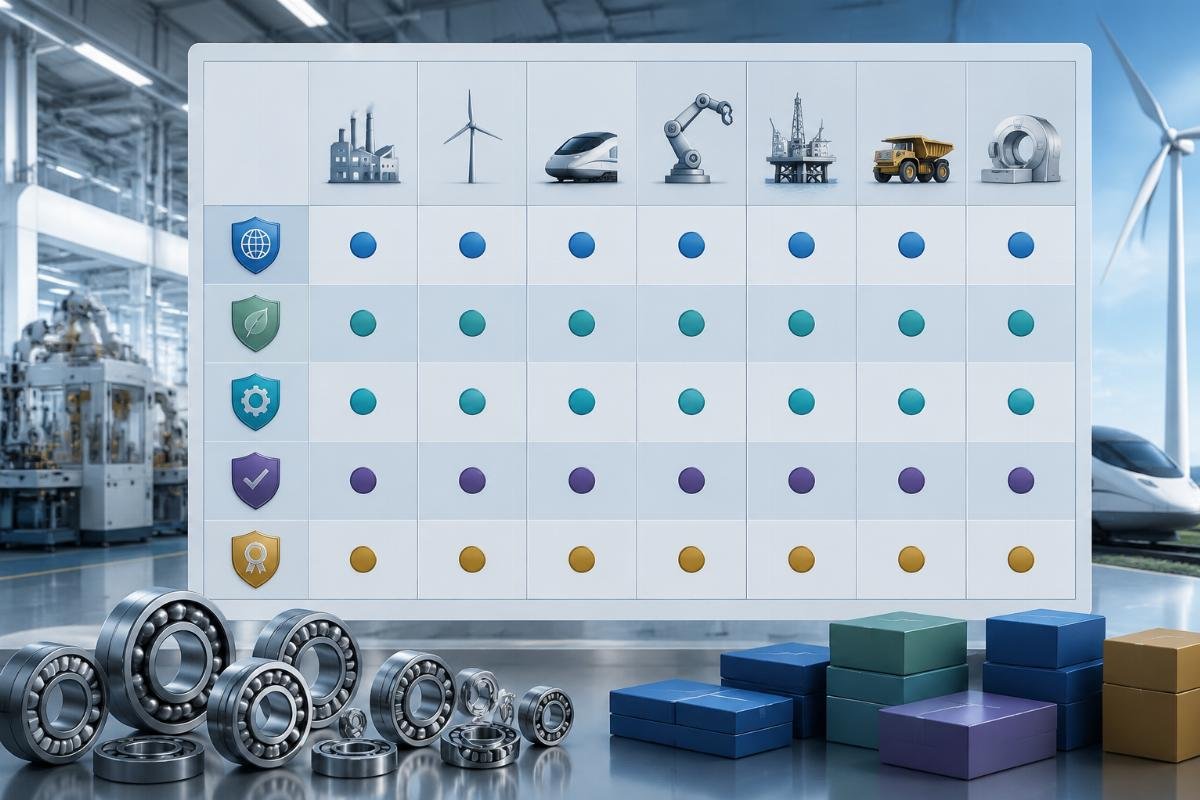
- Identify Application Criticality – Classify bearings as critical, important, or standard to determine required certification level.
- Map Industry Standards – Cross-reference sector-specific requirements (e.g., API for oil & gas, DNV for marine) with ISO/IATF certifications.
- Define Documentation Needs – Specify required deliverables (PPAP, FMEA, MSA) based on application risk profile.
- Establish Testing Protocols

Written by
zhaikevip@gmail.com
Leave a Reply