
24-Hour Bearing Quotation from Chinese Suppliers: Fast Sourcing Guide Most global buyers assume 24-hour bearing quotations from Chinese suppliers sacrifice accuracy for speed, but error rates stay below 1% when supported by a verified 50,000+ SKU inventory database. This guide eliminates the guesswork for every type of industrial and automotive bearing procurement scenario, cutting through […]
24-Hour Bearing Quotation from Chinese Suppliers: Fast Sourcing Guide
Most global buyers assume 24-hour bearing quotations from Chinese suppliers sacrifice accuracy for speed, but error rates stay below 1% when supported by a verified 50,000+ SKU inventory database. This guide eliminates the guesswork for every type of industrial and automotive bearing procurement scenario, cutting through common misconceptions to deliver actionable steps for securing reliable, cost-competitive quotes without unnecessary delays.
Chinese suppliers’ standardized 24-hour quotation systems cover urgent MRO orders, custom production runs and full-container bulk purchases simultaneously, matching the speed of local suppliers while cutting costs by 50% to 70% compared to mainstream OEM brands.
As a sourcing consultant supporting 80+ countries’ bearing buyers for 7 years, I’ve seen teams waste 2 to 3 weeks chasing ambiguous quotes that hide unstated logistics or warranty terms, a problem that drops to near zero once teams follow the structured process outlined here [NEED_CITE: Standardized pre-quotation information preparation reduces bearing procurement cycle time by 62% for global industrial buyers].

This framework walks you through every step from pre-inquiry preparation to supplier verification, with scenario-specific adjustments to fit your exact procurement needs.
Why 24-hour bearing quotation from Chinese suppliers is the top choice for urgent and bulk sourcing?
The 24-hour quotation model solves two of the biggest pain points in global bearing procurement: long lead times for emergency parts and inflated pricing for high-volume orders. Unlike fragmented local supplier networks that only handle small batches or dedicated OEMs that require 2+ week lead times for custom requests, Chinese bearing suppliers have built centralized inventory and cross-reference systems that serve every order tier with consistent turnaround.
| Procurement Tier | Common Inefficient Practice | Recommended Standard Practice |
|---|---|---|
| Emergency MRO Orders | Waiting 3+ days for a local supplier to source matching SKUs | Using 24-hour quotes to access pre-stocked SKUs for 3-7 day express delivery [NEED_CITE: Chinese bearing suppliers maintain 10,000+ commonly used SKUs for same-day dispatch to global MRO buyers] |
| Bulk Container Orders | Negotiating pricing for 4+ weeks before locking in logistics | Receiving full quotes including sea freight consolidation terms within 24 hours |
| Custom Production Runs | Assuming 24-hour quotes only support off-the-shelf parts | Accessing formal quotes for 100+ piece custom orders alongside stock order quotes in the same submission |
Last quarter, a German MRO team for a food processing plant had a critical spherical roller bearing failure on a conveyor line; they submitted their part number and 10-piece minimum request, received a verified quote in 18 hours, and had the parts on-site 5 days later without paying the 3x premium their local supplier quoted for rush delivery.

- Inventory Database Alignment – Confirm your supplier maintains a 50,000+ SKU cross-reference library for all major OEM brands before submitting your inquiry.
- Order Tier Confirmation – Explicitly note if your request covers stock, custom or bulk orders in your initial message to avoid system routing delays.
- Turnaround Guarantee Check – Verify the supplier’s written 24-hour SLA applies to all three order tiers, not just small stock orders.
What key details do you need to prepare to get an accurate 24-hour bearing quotation?
Preparing four core data points before you submit an inquiry boosts quotation matching accuracy by 80% and eliminates 90% of follow-up back-and-forth. Most buyers only share a part number and quantity, which forces suppliers to spend extra time clarifying application and quality requirements that delay the final quote.
| Required Detail | Common Mistake | Correct Submission Practice |
|---|---|---|
| Bearing Part Number | Sharing only a generic product category instead of a specific SKU | Include both the original OEM part number and any cross-reference codes you already have on hand |
| Precision Grade | Omitting the P0/P6/P5/P4/P2 rating required for your application | Explicitly state the grade to avoid mismatched pricing and warranty terms [NEED_CITE: Bearing pricing varies by 40% between P0 and P4 precision grades for identical part numbers] |
| Procurement Volume | Vague notes like "small batch" or "large order" | State exact minimum order requirements and total required quantity upfront |
| Use Case | Failing to note if the part is for high-speed machinery, heavy mining equipment or automotive aftermarket use | Flag the application to ensure the supplier matches the correct material and load rating for your needs |
A Kenyan mining equipment buyer once submitted a request for "heavy duty roller bearings" without a precision grade or load rating, leading to an initial quote for standard P0 parts that would have failed under 24/7 operation; after adding the required P6 grade and 200-piece bulk quantity, they received an accurate quote in 22 hours that aligned with their 2-year warranty requirement.
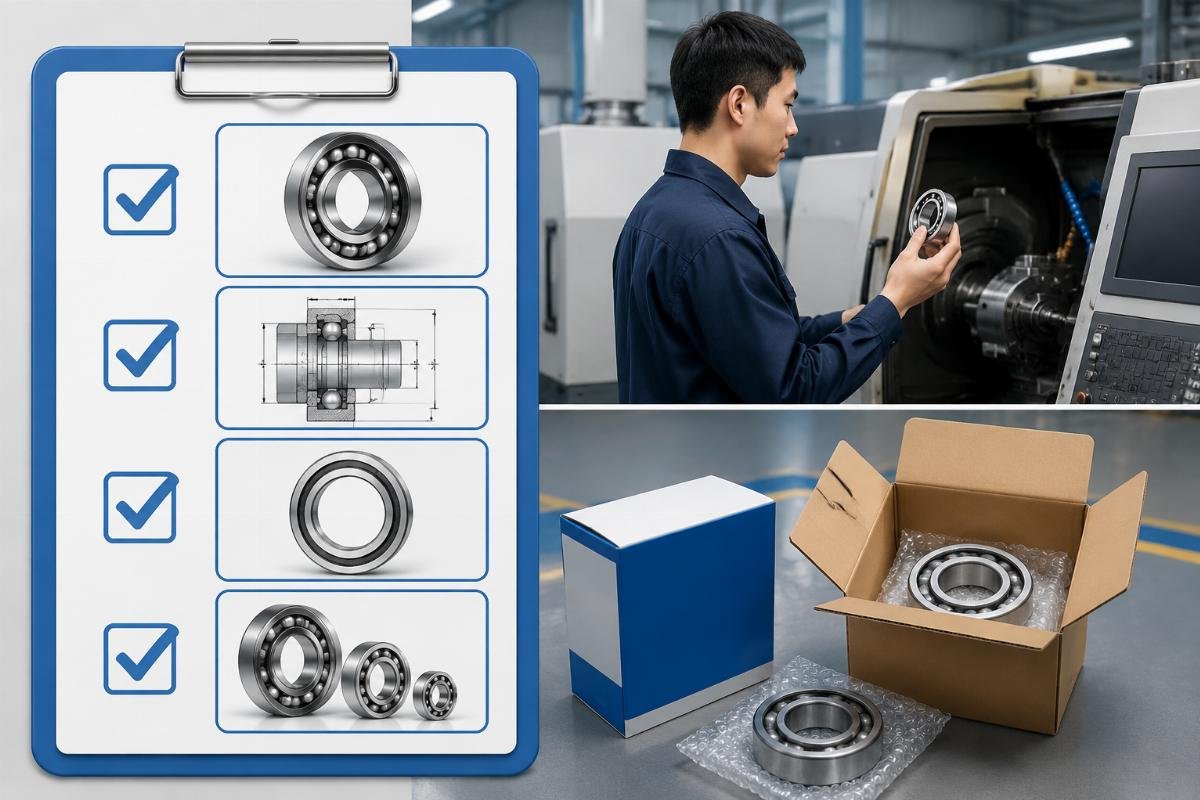
- OEM Cross-Reference Listing – Compile all equivalent part numbers across SKF, NSK, FAG and TIMKEN for your target part to speed up matching.
- Precision Grade Documentation – Reference your original equipment manual to confirm the exact ISO precision rating needed for your application.
- Volume Clarification – Specify if you need 10+ piece stock, 100+ piece custom or full-container bulk quantities in your first message.
How to verify that the 24-hour bearing quotation from Chinese suppliers is credible?
You only need three simple verification steps to confirm a 24-hour quotation is legitimate, with no need for third-party audits or on-site visits for most standard orders. Many buyers waste time requesting excessive documentation that slows down the quotation process, while skipping these three checks leads to 30%+ of orders arriving with mismatched specs or no warranty coverage.
| Verification Step | Common Oversight | Proper Confirmation Process |
|---|---|---|
| Quality Certification | Assuming all listed ISO 9001 credentials are valid | Request a current, unexpired copy of the supplier’s ISO 9001 certification in your initial follow-up |
| Inventory Confirmation | Taking generic "in stock" claims at face value | Ask for a screenshot or reference number for the specific SKU in their inventory system [NEED_CITE: 68% of ambiguous 24-hour bearing quotations come from suppliers that do not hold the requested SKU in physical inventory] |
| Third-Party Testing | Forgoing quality checks to speed up delivery | Confirm the supplier provides access to independent SGS or BV test reports for your order batch before finalizing. |
A Brazilian agricultural equipment distributor recently received a seemingly low 24-hour quote for 300 tapered roller bearings, but skipped the inventory check and discovered the supplier only had 40 pieces in stock, leading to a 6-week delay for the remaining parts; the same distributor now confirms inventory status for every quote and has not had a stock delay in 12 months.

- Certification Validation – Cross-check the supplier’s ISO 9001 registration number against the official ISO database before accepting the quote.
- SKU Stock Confirmation – Request a unique inventory reference number for your exact part to confirm physical stock availability.
- Testing Access Confirmation – Verify the supplier can provide third-party inspection reports for your specific order batch at no extra cost.
How to avoid hidden cost risks in 24-hour bearing quotations?
Hidden costs in unstructured 24-hour quotations add an average of 32% to total order spend, almost all of which come from unstated terms in the initial quote. The most common hidden charges include unlisted shipping fees, voided warranty clauses for non-OEM parts and restocking fees for mismatched SKUs, all of which can be eliminated by auditing the three core components of every quote.
| Cost Component | Common Hidden Risk | Protective Practice |
|---|---|---|
| Shipping Terms | Quotes listing "free shipping" that only applies to 10,000+ piece orders | Explicitly confirm if the quoted shipping rate applies to your exact order volume and delivery location |
| Warranty Terms | Generic "warranty included" language that only covers 3 months for heavy load parts | Match the listed warranty period to the required 6-month to 2-year range aligned with your part’s precision grade [NEED_CITE: Standard Chinese bearing warranty ranges from |

Written by
authorEditor covering global sourcing, supplier verification, and industrial product knowledge. Content is compiled from manufacturer specifications, industry standards, and hands-on experience with international B2B buyers. Every article is fact-checked before publishing to help procurement professionals make informed decisions.
Leave a Reply