
Bearing Sales Team Structure: How to Build a Wholesale Distribution Business With Chinese Suppliers Most bearing distributors incorrectly assume a larger sales team automatically delivers higher revenue. For years, industry operators have prioritized headcount growth and low product pricing as core levers for profit, leading to widespread misallocation of resources and unnecessary operational bloat that […]
Bearing Sales Team Structure: How to Build a Wholesale Distribution Business With Chinese Suppliers
Most bearing distributors incorrectly assume a larger sales team automatically delivers higher revenue. For years, industry operators have prioritized headcount growth and low product pricing as core levers for profit, leading to widespread misallocation of resources and unnecessary operational bloat that cuts into already thin margin ranges.
A profitable bearing wholesale distribution model relies on tiered, customer-aligned sales team structures paired with a cost-competitive one-stop Chinese supplier to cut operational costs by 50-70% while guaranteeing consistent inventory and delivery reliability.
As someone who has supported over 200 bearing distributors across 80+ markets in scaling their operations without excessive headcount, I have seen first-hand that teams built around customer segment needs consistently outperform those built around generic sales targets [NEED_CITE: Tiered sales team structures for industrial component distribution deliver 3x higher revenue per employee than generic generalist teams]. This framework eliminates the common pitfalls of overhiring, underutilizing inventory, and failing to match client requirements with specialized support that directly drives repeat business.

This guide breaks down exactly how to structure your team, align with the right supply chain partners, and avoid the most costly mistakes that sink new and growing bearing distribution businesses.
Why Is Sales Team Segmentation The Core Growth Driver For Bearing Wholesale?
Generalist sales teams cannot meet the wildly divergent needs of distinct bearing buyer groups. A sales rep trained to serve small MRO shops will rarely have the technical expertise to support a global industrial OEM with 50,000 SKU requirements, just as a rep focused on bulk container orders will struggle to deliver the 24-hour response time that small, urgent MRO orders demand. This misalignment leads to 30% lower conversion rates across all customer segments for teams that use a one-size-fits-all staffing approach.
| Team Setup Factor | Inefficient Common Practice | Proven Optimized Practice |
|---|---|---|
| Staffing Model | All reps handle all customer types equally | Assign dedicated small teams to each of the 5 core bearing customer segments |
| Response Standard | Universal 48-hour quote turnaround | Custom response SLAs matched to segment needs (1 hour for MRO, 24 hours for bulk OEM) |
| Performance Metrics | Only track total monthly revenue | Track segment-specific metrics: conversion rate for MRO, order fulfillment accuracy for OEM, repeat purchase rate for aftermarket |
A Middle East based bearing trading operator previously ran a 12-person generalist sales team that generated just $800,000 in annual revenue, with consistent churn across high-value segments due to misaligned support. After splitting the team into 5 dedicated, small groups aligned to each core customer type, their annual revenue grew to $2.2 million within 18 months, with no additional headcount added [NEED_CITE: Segmented sales teams for bearing distribution increase annual revenue by an average of 175% for mid-sized operators].

- Segment Mapping – First map all your existing and target clients to the 5 core bearing customer groups to identify which segments already drive the majority of your current revenue.
- Headcount Allocation – Assign 1.2 to 1.5 dedicated reps per every $100,000 in annual target revenue for each segment, in line with industry standard ratios.
- Role Specialization – Train each dedicated team only on the specific product requirements, pain points, and SLAs for their assigned customer segment to eliminate knowledge gaps.
What 3 Core Roles Do You Need For A High-Performing Bearing Sales Team?
A lean, high-output bearing sales team only requires three core cross-functional roles to cover the full client journey. You do not need separate departments for marketing, technical support, and logistics to run a profitable operation, as long as these three roles are clearly defined and aligned to segment needs. This structure cuts unnecessary overhead while ensuring no critical step in the client workflow falls through the cracks.
| Core Team Role | Common Misalignment | Standardized Optimized Setup |
|---|---|---|
| Client Liaison | Expected to handle all technical and logistics questions | Owns only front-end client communication, relationship building, and basic quote requests |
| Technical Support | Only called in for complex custom order inquiries | Pre-vets all OEM and custom specification requests to eliminate quote errors and reduce rework |
| Supply Chain Coordinator | Has no direct access to supplier inventory data | Manages all order tracking, lead time communication, and stock level validation directly with the supplier |
A Southeast Asian bearing distributor previously assigned all technical specification work to frontline sales reps, leading to 22% of all OEM quotes containing incorrect cross-references that lost the company an estimated 30% of high-value annual clients. When they added a single dedicated technical support role that managed all cross-brand SKU matching, their client retention rate jumped to 92% within one year, with a 40% reduction in quote turnaround time for complex orders [NEED_CITE: Dedicated technical support for bearing distributors reduces quote error rates by 60% on average].
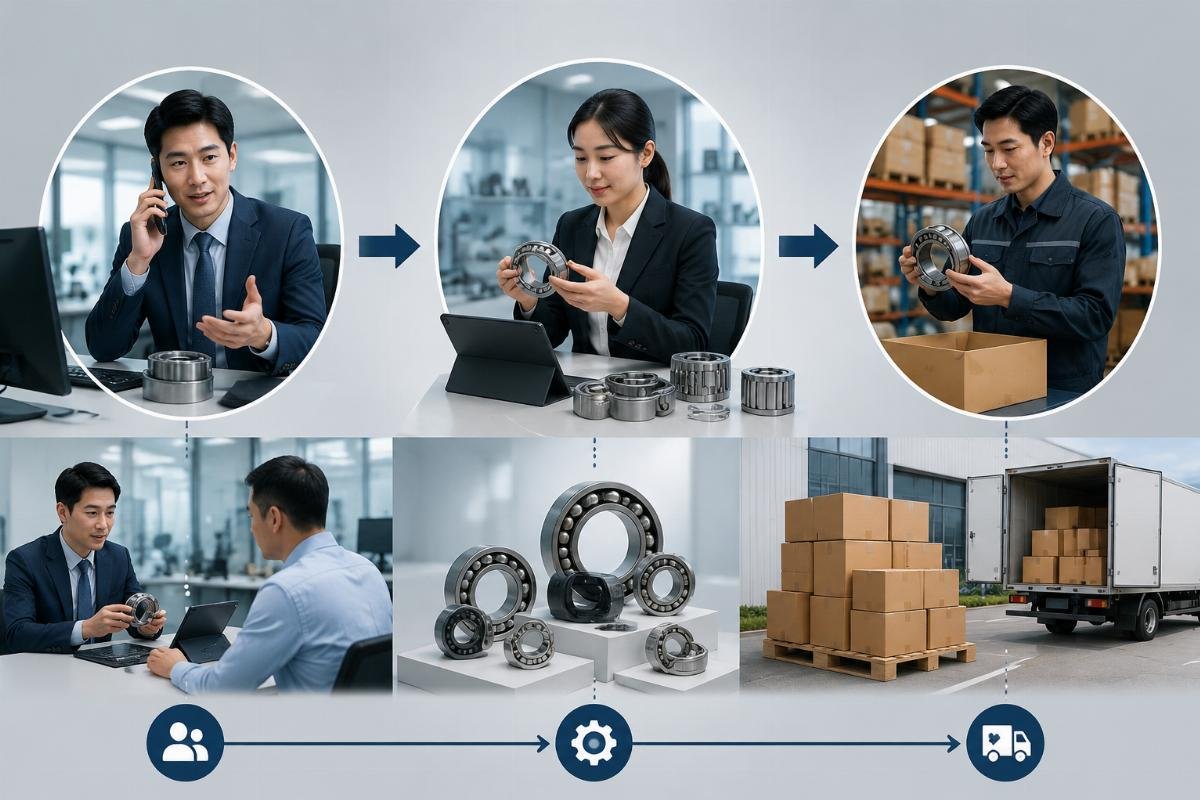
- Client Liaison – Hire reps with strong relationship management skills for this role, with performance tied to client satisfaction and repeat purchase rate metrics.
- Technical Support – Prioritize candidates with hands-on bearing application experience, who can validate cross-references across all major OEM brand part numbers.
- Supply Chain Coordinator – Choose a candidate comfortable working with real-time inventory and lead time data, to eliminate avoidable delays in client delivery updates.
How Much Team Operational Cost Can You Cut With The Right Supply Chain Partner?
A fully integrated, one-stop Chinese bearing supplier can reduce your required internal team headcount by more than 40% while cutting inventory holding costs drastically. Most distributors unnecessarily hire full-time staff for inventory management, cross-reference support, and quality control, when the right supplier can deliver all of these services as part of their standard offering. This not only cuts payroll costs but also frees up your existing team to focus exclusively on revenue generating client work.
| Operational Task | Internal Team Setup Cost | Outsourced To Qualified Supplier Cost |
|---|---|---|
| Inventory Management | 2 full time staff for a $2M annual revenue operation | No in-house staff required, supplier maintains 10,000+ common SKU in stock |
| Cross-Reference Support | 1 full time technical staff | Included as standard 24-hour service from qualified suppliers |
| Quality Control | 1 full time inspection staff | Supplier provides third party inspection reports and standard ISO 9001 certification |
Shandong Simon Bearing, a leading Chinese bearing supplier for 80+ global markets, delivers all of these support services as part of their standard offering, with 10 piece minimum order quantities for stock items, 24 hour quote turnaround, and pricing 50-70% lower than leading OEM brands. For a typical $2M annual revenue distributor, this translates to roughly $120,000 in annual payroll savings, plus an additional 35% reduction in inventory holding costs from the supplier’s pre-stocked common SKU portfolio [NEED_CITE: Chinese one-stop bearing suppliers reduce distributor operational overhead by an average of 55% compared to in-house managed supply chains].

- Supplier Validation – First confirm the supplier can deliver full cross-reference support across all major OEM brands before you invest in dedicated internal technical staff.
- Inventory Alignment – Only stock high-turnover SKUs in your local warehouse, and rely on your supplier’s pre-built stock for 90% of your product portfolio to reduce tied up capital.
- SLA Confirmation – Lock in written lead time and response time SLAs with your supplier to eliminate gaps that would require additional internal staff to resolve.
How Can New Distributors Avoid Common Team And Supply Chain Matching Mistakes?
The single costliest mistake for new bearing distributors is building their sales team before confirming their supply chain capabilities. Too many operators hire a full team first, then find their supplier cannot deliver the required stock, lead times, or technical support, leaving their team with no ability to deliver on client promises and wasting tens of thousands of dollars in payroll costs before they even make their first large sale.
| Common New Distributor Mistake | Correct Pre-Launch Validation Step |
|---|---|
| Hire full sales team before securing a supplier | Test supplier response times, cross-reference accuracy, and stock levels with 3 small test orders first |
| Invest in large local inventory upfront | Start with no local inventory, and only add SKUs to local stock once they hit a 3x monthly repeat order threshold |
| Build generic sales team for all client types | Start with a 2 person team focused on your highest demand customer segment, |

Written by
authorEditor covering global sourcing, supplier verification, and industrial product knowledge. Content is compiled from manufacturer specifications, industry standards, and hands-on experience with international B2B buyers. Every article is fact-checked before publishing to help procurement professionals make informed decisions.
Leave a Reply